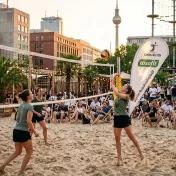
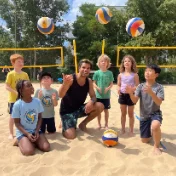
Your kid has been running through the sand for two hours, has sand in their hair, sand in their ears, and still refuses to go home. That is where beach volleyball starts – not with a technique, but with a child who wants to chase balls. And in Berlin you do not have to wait for the summer holidays: beach volleyball training for kids runs all year here, outdoors in the sand in summer and in the heated hall in winter.
In Japan, the volleyball federation does not start with a volleyball. It starts with a balloon. The Japan Volleyball Association’s 2025 business plan includes a dedicated kindergarten programme in which pre-school children work with balloons instead of balls – explicitly as ball coordination training, across nine regions of the country, 30 to 40 children per session. Once you know that, you stop asking when your child will finally set the ball cleanly, and start asking what can actually be learned in these years.
What age? The honest answer has three numbers
A child can play in the sand as soon as it can walk. Learning volleyball is a different matter. That is why federations separate the two cleanly: before school it is about throwing, hitting and waiting, with a ball that flies slowly enough. Technique comes afterwards.
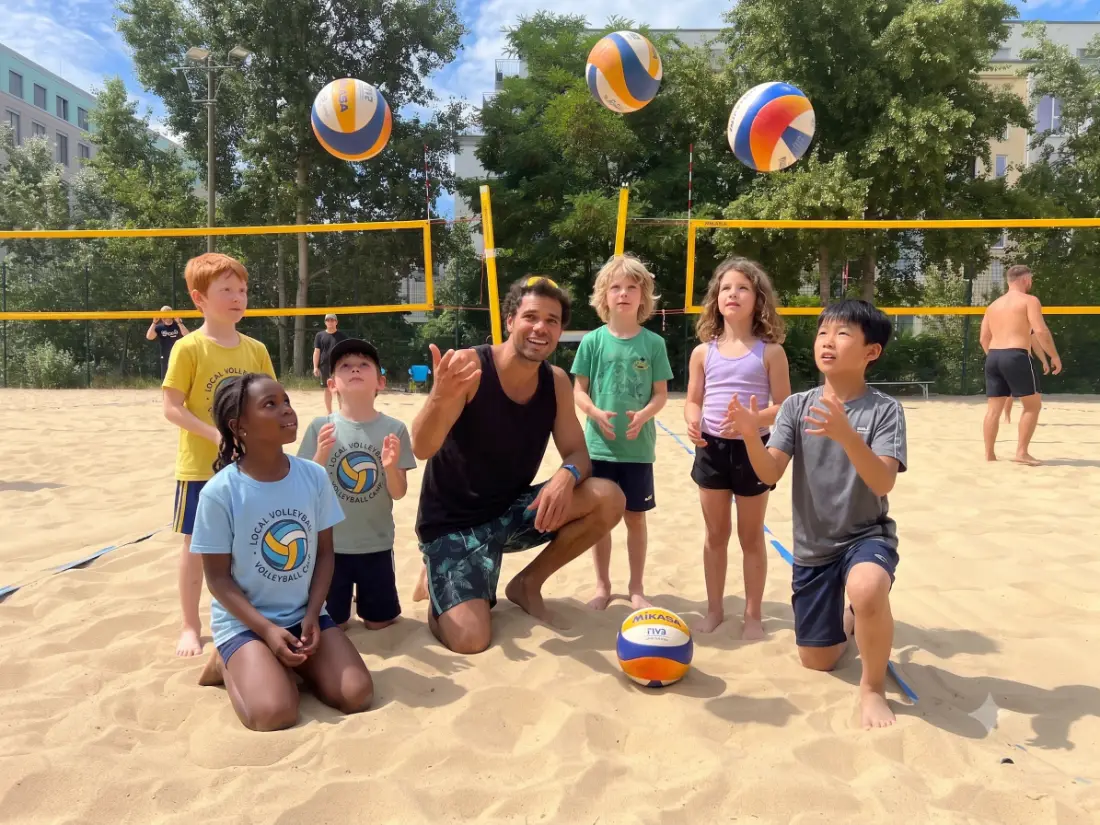
Structured training makes sense from eight. For its 2026 national primary school championship, the Japanese federation admits children born in 2014 or later – so twelve at most. Selective talent identification only starts in year five, at around ten. Before that, children play; they are not picked. Our kids camps in Berlin are built on the same logic: ages 8 to 13, groups by age, a maximum of eight children per coach.
Beach volleyball as a competitive sport starts later than parents assume. The youngest category in the Japanese federation’s national beach calendar is U15 – and even that is partly played four-a-side rather than two-a-side. Below that, no national beach category exists. The route runs through school and indoor formats first, and only then into the sand. So starting at eight is not late. Planning ranking tournaments in the sand at eight is about six years early.
Why sand is the better surface for children
Sand costs more effort and less joint load. That is not a marketing line, it is measurable. The sand training review by M. J. Binnie and colleagues compares peak braking forces on dry beach sand with those on grass:
Peak braking forces while running. Source: Binnie et al., Journal of Sports Sciences, 2014.
A quarter of the impact, in other words. We have no direct comparison with an indoor floor, and we say so deliberately – but an indoor floor is certainly not softer than a lawn.
At the same time, sand is harder work. The study by T. M. Lejeune, P. A. Willems and N. C. Heglund in the Journal of Experimental Biology (1998) puts the energy cost of running in sand at 1.6 times that on firm ground, and walking at 2.1 to 2.7 times. For children that means: two hours with breaks is a full training day for a ten-year-old – and that is exactly how long a camp day runs with us.
Barefoot is part of the training, not a lack of shoes. The research group around K. Hollander examined 810 children and adolescents aged 6 to 18 in Scientific Reports (2017) and found a significantly higher static arch in habitually barefoot children. Sand delivers that stimulus in passing – which is why no child needs beach shoes with us. What else to bring is covered in our equipment guide.
And on injury risk there is a number that needs honest framing. T. Juhan and colleagues analysed US college volleyball players who compete both indoors and on sand:
Source: Juhan et al., Orthopaedic Journal of Sports Medicine, 2021. Adult competitive athletes, not children – there is no injury data for children in beach volleyball.
What happens in good kids training – and what does not
You recognise good kids training by the ball staying in the air, not by the technique being clean. The handbook of the Japan Sports Agency for primary school PE prescribes for net games: three against three, a very light ball, up to two touches per child and four per team instead of the usual three. The stated goal is not clean technique, but that the rally keeps going.
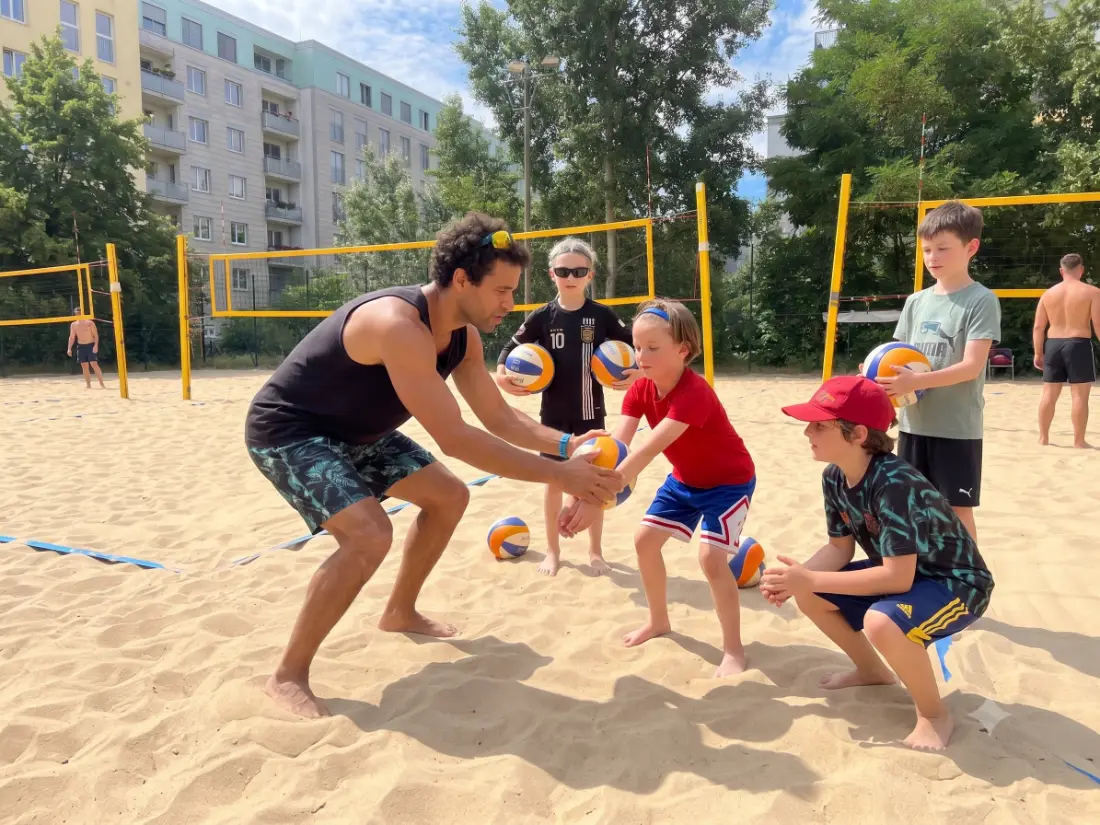
Smaller court, lower net, lighter ball – and then play immediately. In Asia that is not a recommendation, it is a rule. The Japanese primary school volleyball federation prescribes:
| Adults | Primary school | |
|---|---|---|
| Court | 18 × 9 m | 16 × 8 m |
| Net height | 2.43 m | 2.00 m |
| Ball weight | 260–280 g | 200–220 g |
| Ball circumference | 65–67 cm | 62–64 cm |
Source: competition rules of the Japanese primary school volleyball federation. The tender for Beijing primary schools independently arrives at the same court dimensions.
And one finding that contradicts the textbook: Satoshi Hanawa of the Niigata University of Health and Welfare had fifth-graders play three against three and allowed them to catch the ball on reception and briefly hold it when setting. The attack success rate rose above 80 per cent. Children who are allowed to catch first learn where to stand. Clean setting comes afterwards – and then faster.
Four drills that work at home or in the park
All four follow the same principles: light ball, many contacts, play before technique.
Keep a balloon up overhead. Both hands, hands above the forehead, the balloon must not touch the floor. It flies slowly and forces the child to move underneath the ball and wait – exactly the movement that counts in the sand later. Modelled on the Japanese federation’s pre-school format.
Catch – set – catch. In threes: the first catches, throws high to the second, who catches and feeds the third, who hits it back. Three contacts, no technical pressure. Following Hanawa’s finding, the most effective step towards the real game.
Barefoot target throwing in the sand. A towel as the target, thrown from a lunge. Accuracy, stability on soft ground and foot muscles in one drill.
Wall rally with two touches. Light ball against a wall, two contacts allowed before the ball has to go back. The rule relaxation comes straight from the Japanese curriculum.
What that looks like in the living room
Two minutes, from the US channel Better at Beach: a father shows how he teaches his kid the first ball contacts at home – no net, no sand, just whatever is around.
Sun, heat and drinking: the numbers parents actually need
More than 90 per cent of a lifetime’s UV dose falls in childhood and adolescence. That figure comes from the Global Solar UV Index published by WHO, WMO, UNEP and ICNIRP. The same source states that dry beach sand reflects around 15 per cent of UV radiation – so on a beach court the radiation does not only come from above.
The German Federal Office for Radiation Protection gets specific: from UV index 3 you belong in the shade around midday, from UV index 8 preferably indoors; its rule of thumb is that between 11 and 3 you stay out of the sun. Sun protection factor 30 is the minimum, 50+ for children. The German Federal Institute of Public Health adds: apply about 30 minutes before going out, reapply roughly every two hours. And a parasol is not full protection – it reduces UV radiation by up to 30 per cent, a dense tree canopy by 20 per cent.
The one sentence parents should remember. “Reapplying does not extend the protection. It only maintains it.” That is how the Federal Office for Radiation Protection puts it – creaming at ten and topping up at midday does not buy extra hours, it merely keeps the protection alive.
Heat is not the problem. Not drinking is. The 2011 policy statement of the American Academy of Pediatrics clears up a widespread misconception: children do not regulate heat worse than adults as long as they drink enough. The risk factors are dehydration, excessive load, too little recovery and unsuitable clothing. Wolfgang Lawrenz of the children and youth sport commission of the German Society for Sports Medicine and Prevention gives numbers: 5 to 7 millilitres per kilogram of body weight 15 to 30 minutes before exercise, 10 to 13 millilitres per kilogram per hour during it. For a 30-kilo child that is roughly 150 to 210 millilitres beforehand and 300 to 390 millilitres per training hour.
Beach volleyball training for kids in Berlin: what is actually on offer
The practical advantage of Berlin is that the season does not end in September. From spring to autumn, beach volleyball training for kids runs outdoors at Beach Mitte, Caroline-Michaelis-Strasse 8 in 10115 Berlin, and from November in the heated winter hall at the same location. For parents that means no club switch in October and no six-month break.
The kids camps run at the weekend, Saturday and Sunday, with two training hours per day. Groups are split by age, a maximum of eight children per coach – that is where providers differ most, because in a group of twenty each child gets a fraction of the ball contacts. Head coach is Mack McKelton, holder of a C coaching licence and a Master of Education in Sport and English; sessions are run in German and English.
No prior experience is needed, balls and court fees are included, and everyone plays barefoot. You book online and pay only after personal confirmation – no prepayment, and free cancellation up to one week before.
The four most common parent mistakes
Demanding clean technique too early. A child allowed to catch the ball learns positioning faster than one constantly corrected for a double contact. Technique arrives once the game is running.
Coaching from the sideline. Two sets of instructions at once – one from the coach, one from the parents – add up to none. Watching is explicitly welcome with us. Coaching along is not.
Counting results instead of ball contacts. Whether a ten-year-old wins a match tells you almost nothing. How often they touched the ball tells you almost everything.
Sunscreen only in the morning. Two hours of training means at least one reapplication. Reapplying does not extend the protection, it only maintains it.
Frequently asked questions
From what age can my child join?
Our kids camps are designed for ages 8 to 13, with groups split by age. Younger than eight rarely makes sense: before that it is less about volleyball and more about general ball coordination, which works just as well with a balloon in the living room. At the top end, 13 is not a hard limit – older teenagers are often better placed in the adult camps.
Where can children train beach volleyball in Berlin?
Our beach volleyball training for kids takes place at Beach Mitte, Caroline-Michaelis-Strasse 8 in 10115 Berlin – outdoors in the sand in summer, and from November in the heated winter hall at the same site. Camps run at the weekend, Saturday and Sunday, with two training hours each day. Beyond that, Berlin has beach courts spread across the whole city.
Does my child need to know volleyball already?
No. No prior experience is required, and most children arrive without any. Setting, passing and serving are trained – wrapped in games rather than drill sequences. Balls and court fees are included, everyone plays barefoot, and nobody needs beach shoes.
Is beach volleyball dangerous for children?
It is one of the lower-contact ball sports: no body contact with opponents, a soft surface, and markedly lower impact forces than on firm ground. There is no reliable injury data specifically for children in beach volleyball – we would rather say so than invent a number. The available adult data shows roughly a third of the indoor injury rate on sand.
How long should a child train in one go?
Two hours with drinking breaks is a full day for primary school children in the sand – running in sand costs about 1.6 times the energy of firm ground. That is exactly what our kids camps are built around: two training hours per day on Saturday and Sunday, with breaks as needed rather than by the clock.
Do parents have to be there?
No. Parents are welcome to watch but do not have to. Either is fine – as long as nobody coaches from the sideline.