There is a sentence heard on Berlin sand every weekend: “I’m just too short for beach volleyball.” It is a comfortable sentence, a consoling one – and wrong. Because nobody jumps high on sand anyway. The surface absorbs your power, and even World Tour players do not reach their indoor numbers outdoors.
The real difference between an attacker who scores and one who gets dug is not jump height. It is whether the ball ends up where nobody is standing. This article is about learning that – without a single extra centimetre of jump.
The one insight that changes everything
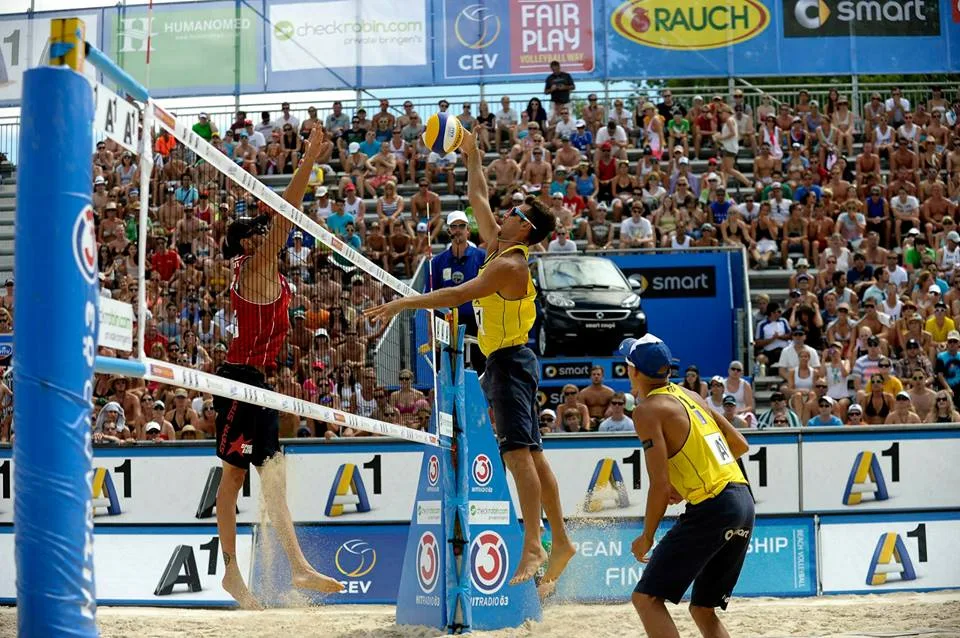
A point happens when the ball touches the sand. Not when it was hit hard. On a beach court your opponents have two people for 128 square metres – covering everything is literally impossible. Your job is not to hit harder than the defender can react. Your job is to put the ball into one of the many gaps.
Which leads to the second, even more important insight: you do not decide your attack in advance. Anyone who already knows during the approach that they will hit cross-court is playing against themselves. Good attackers decide just before take-off – based on what they see on the other side.
The glance that makes the difference
Just before you jump, take a quick look at the defender. Where are they? Are they already moving somewhere? That single glance is the entire basis of attacking tactics in beach volleyball. Without it you are guessing. With it you know.
The five attacks you will need
Anything not hit with full power is called a shot in beach volleyball. Five of them will last you years.
When: The defender sits deep cross-court or is cheating towards the line.
How: A very sharp, cut ball into the tight angle, landing about a metre behind the net on the far sideline. It should skid low over the net – then it is barely diggable. The single most effective shot on sand.
When: The blocker takes the line, the defender covers cross-court.
How: Over the block and deep into the corner behind the blocker. The bread-and-butter shot: it punishes exactly the defence waiting for your cross-court swing.
When: The defender starts drifting backwards.
How: Same direction as the line shot but shorter: just past the block yet in front of the defender. It works because it looks like the deep ball.
When: The defender is well forward or has already started moving.
How: A high, deep ball over the defender into the back corner. Looks harmless and is extremely awkward to chase backwards through sand.
When: The block is high and you cannot get over it.
How: Played with the knuckles rather than the palm. The aim is to put the ball behind the block. The poke is also your rescue ball when the set comes in too tight to the net.
What the opponent gives away – and how to use it
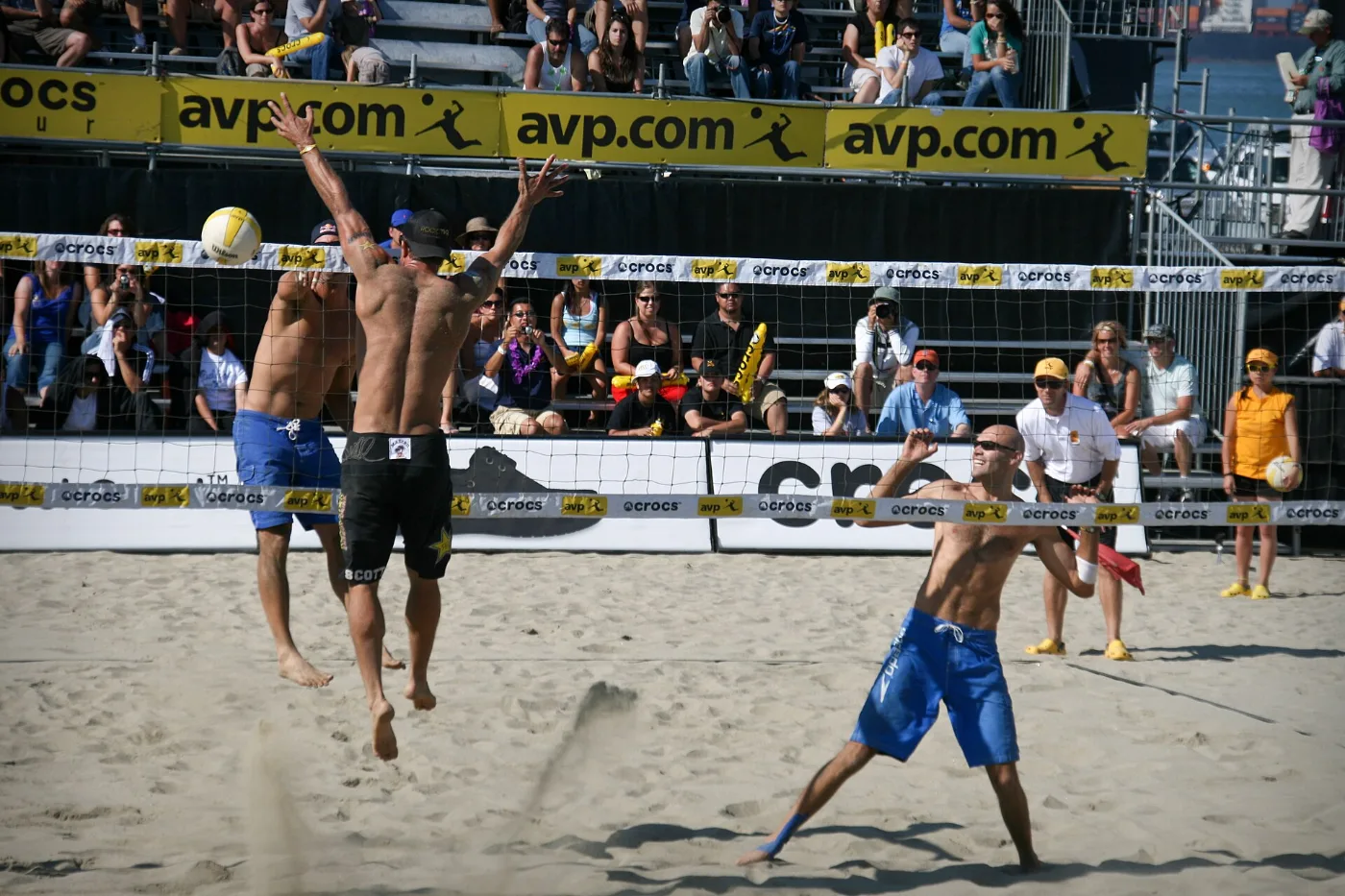
On the other side stand two people with clear jobs. The blocker reads you, the defender reads you, and both give themselves away constantly.
The mistake that costs beginners most
Not the missing jump. Predictability. Hit cross-court three times in a row and the fourth time you face a defender already standing there before the ball is struck. The order of your attacks is itself a weapon.
One pattern that works almost every time at recreational level: twice the same direction, then the opposite. The opponent adjusts after the second one – and then runs to the wrong corner.
And a second, equally costly mistake: not looking at the set. A ball that arrives too tight to the net does not allow a normal attack. Notice it only in the air and you hit the net. Notice it early and you poke, keeping the rally alive.
Technique: what actually matters on shots
Shots are not a weak version of a swing. They have their own technique, and the decisive property is: they should look like a swing.
- Same approach, same take-off, same arm swing. Only the hand changes at the last moment. Visibly switching into shot mode gets you read.
- On the cut shot the hand stays open and cuts across the side of the ball. Do not push – cut. That produces the flat, quick ball that barely rises over the net.
- On the line shot the hand goes under the ball and accompanies it. No hitting, a controlled guide. Depth comes from the wrist, not the arm.
- On the poke the fingers are firmly bent, contact with the second knuckles. That is expressly legal – open fingertips are not.
Three drills that need no jumping power
1. Towel cross-court (solo or pairs). Put a towel in the tight angle and hit 20 cut shots at it. Start standing, then jumping. It is only about the contact point on the side of the ball.
2. Live defender drill (pairs). Your partner stands as defender and randomly changes position while you approach. You must play into the open half. This trains exactly the pre-jump glance.
3. Five-shot round. Five balls in a row, each a different shot: cut, line, baby line, jumbo, poke. Sounds easy, is not – and afterwards you have a repertoire instead of a habit.
Common questions
If I only play shots, doesn’t that become predictable too?
Yes. Which is why the hard swing stays in the mix – as a surprise, not a default. The mixture is what makes you unreadable.
I barely jump. Is jumping worth it at all?
Yes, but not for the height. From the air you get more angles and more time to look. Even a low jump beats attacking from the ground.
When should I start learning shots?
Immediately. There is no argument for swinging hard for a year first. Learn shots early and you win matches earlier.
Shots are not learned by watching
In our camps attacking variation is its own block: cut, line, baby line and poke with direct feedback and target drills. Groups by level, no more than eight people.