The serve is the only situation in beach volleyball where you alone decide what happens. No opponent interferes, no partner is involved, no wind forces you into a movement. You have the ball, you have time, and you choose. Which makes it all the more painful that for recreational players the serve is the shot that most often gives points away.
A service error is the only point in the game your opponent receives without doing anything at all. No block, no dig, no movement. They stand there and get a point. This article shows you how to stop that – and then how to turn the serve from a chore into your best weapon.
The three serves you need
There are dozens of variations, but at recreational and improving level three of them cover practically everything.
1. The standing float serve – your foundation
From standing, no jump, with the palm. The goal is a ball with no rotation. A spinless ball behaves in the air like a knuckleball in baseball: it wobbles, tips away, suddenly drops – unpredictably, including for you. That is exactly where its effect comes from.
The decisive points:
- Toss low and in front of the hitting arm. The higher you toss, the more can go wrong. A toss you can barely follow upwards is too high.
- Contact exactly in the middle of the ball, with the centre of the palm – not the fingers. Finger contact creates rotation, and rotation destroys the float.
- Firm wrist, short backswing, clear stop. No follow-through like an attack. The serve is a punch, not a sweep.
2. The jump float – the most common weapon
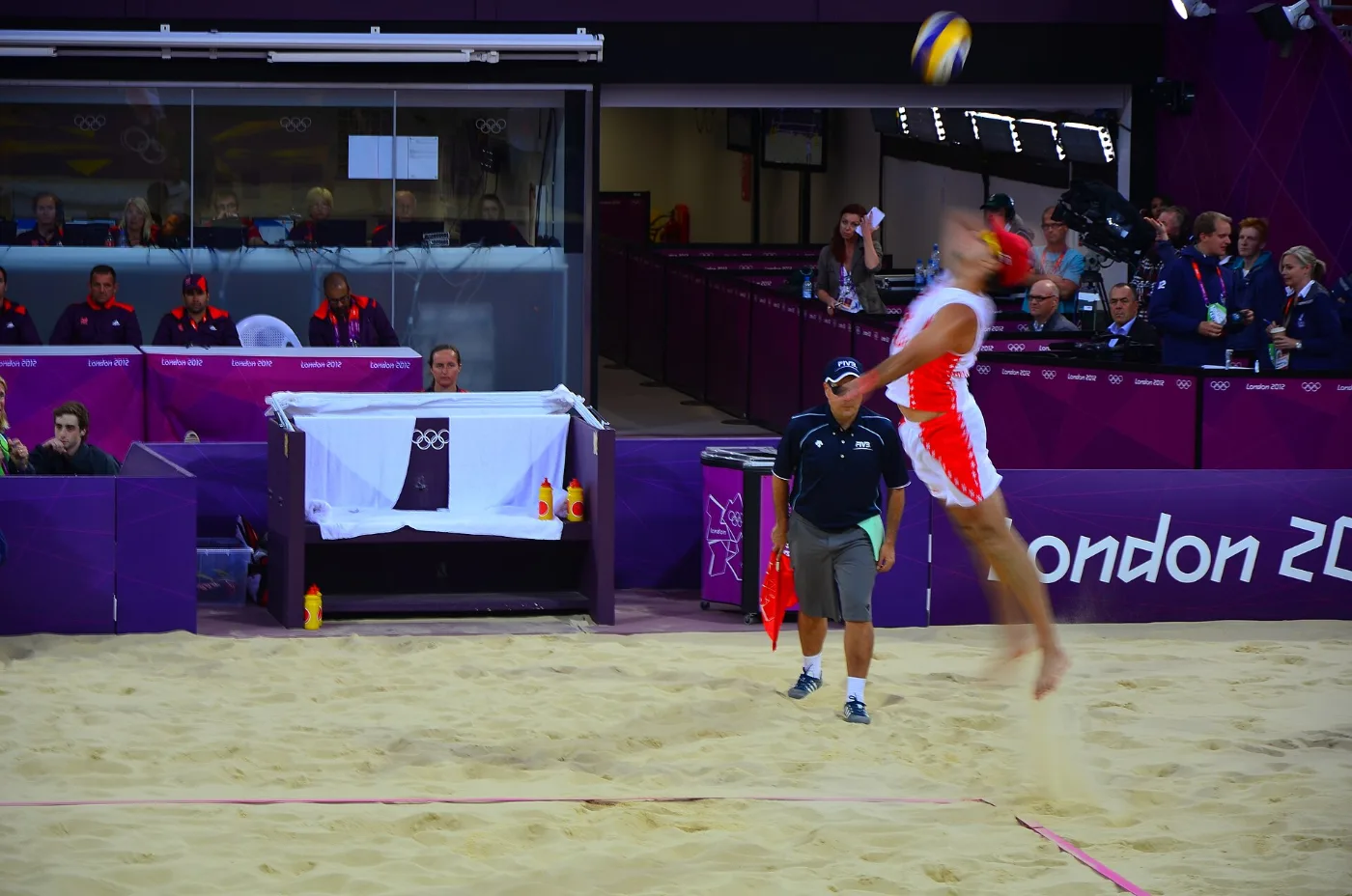
The same contact as above, only out of a jump. The advantage is not power but angle: you meet the ball higher and can send it flatter over the net, which takes time away from the opponent.
The rhythm is surprisingly simple: step with the left foot while tossing the ball – then a quick right, left into the jump, and meet the ball in the air. The most common error is a toss so high it forces you to wait for the ball in mid-air.
3. The jump topspin serve – the ace shot
The classic point-scoring serve, and by far the riskiest. It only pays off once your float serve is reliable. Anyone attempting it on every serve at a recreational tournament loses more points than they win.
Wind: the part almost everyone ignores
On the serve, wind is not interference but a tool – if you use it properly.
Serving into the wind makes the float work hardest. The resistance amplifies the erratic flight path. Given the choice, serve into the wind.
In a crosswind, serve against the wind direction. If the wind blows right to left across the court, serve from left to right. If it blows left to right, serve right to left. The ball then travels against the flow and moves as much as possible.
In strong wind: control before power. Very windy days are not the float serve’s hour – the movement becomes unpredictable for you too. Then it is no longer about aces but about getting the ball in and the opponent into an awkward position.
In light wind: float time. The float serve works most reliably in calm air, because the ball then does exactly what you aimed for.
Where to serve? The tactics that make the difference
Technique decides whether the ball lands. Target choice decides whether it hurts. Four principles, in this order:
Principle 1: find the weaker passer
It sounds obvious and is still rarely done. If one of the two opponents is visibly weaker at passing, they get every ball. Every one. Including the tenth in a row – especially the tenth in a row.
Principle 2: if both pass equally well, occupy the better setter
This is the trick advanced players know and beginners do not: if one player passes better and sets better, you serve at them. Because whoever passes the ball cannot set it. The result is that the weaker setter has to set every second ball.
Principle 3: alternate short and deep
A short ball, especially into the corners or the seam between the two players, is awkward as soon as the passers stand a little too deep. And it pulls the passer forward – where two people then stand in a small space getting in each other’s way.
A deep ball by contrast forces a pass above head height. That is exactly where shanks come from. Alternating short and deep unsettles even good passers.
Principle 4: force movement
The simplest rule of all: a passer who has to move both feet makes considerably more errors than one who can stand still. One to one and a half metres of movement is already enough. So you do not need to serve harder – you only need to serve somewhere other than where they are standing.
The decision guide for match situations
How to actually train the serve
The usual mistake in serve practice: hit five balls, collect them, carry on playing. That improves nothing. The serve is the easiest skill in the entire sport to train in isolation – use that.
Three sets that fit into 15 minutes
Set 1 – reliability: 20 serves, target simply “in”. Note the percentage. Below 90 % you work on nothing else.
Set 2 – accuracy: put a towel in one corner. 20 serves at the towel. Not harder, just more precise.
Set 3 – under fatigue: after playing, another 20 serves with heavy legs. That is exactly the situation in your fifth tournament match, and exactly where serving percentages collapse.
The three most common serving errors at recreational level
Tossing too high. Every centimetre of toss height is another centimetre where something can go wrong. The toss is the real technical core of the serve – stabilise it and you halve your error rate.
Contacting with the fingers instead of the palm. Creates rotation, kills the float and makes the ball easy for the opponent to read.
The same serve to the same spot every time. After the third identical ball the opponent is already standing there before you have hit it. Variation costs you nothing and works immediately.
Common questions
Should a beginner learn the jump serve?
Only once your standing serve is over 90 % in. Before that you are just adding sources of error.
How hard should I hit it?
Hard enough that 9 out of 10 land in. Anything beyond that wins applause and loses sets.
Why does my ball not float?
Almost always rotation. Check: are you contacting the middle of the ball with the palm, and does your hand stop after contact – or are you following through?
The serve improves faster than anything else
In our camps the serve is a fixed part of every session – with video checks of the toss and target series. Groups by level, no more than eight people.