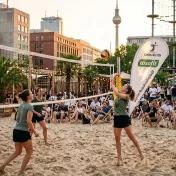
The good news first: beach volleyball is one of the safest ball sports there is. Sand absorbs what goes into your joints indoors. The bad news: if something does get you, you are out for longer than an indoor player with the same injury.
Studies count roughly four to five injuries per 1,000 playing hours in beach volleyball. At two hours a week that is statistically one injury every five years. In training the figure is far lower than in competition.
What actually breaks in the sand
Injury research distinguishes two groups, and they behave completely differently.
Acute injuries – the moment something happens. More than half of them occur in just three places: knee around 30 per cent, ankle around 17 per cent, fingers around 17 per cent. The finger is the classic beginner problem: a hard-hit ball meets a spread hand while blocking or setting.
Overuse problems – the creeping kind. Here the lower back leads with around 19 per cent, followed by the knee at 12 and the shoulder at 10 per cent. They do not happen in a moment but over weeks.
And where it happens surprises many: most injuries occur in court defence and attacking – not at the net, where you would expect them.
Why you are out for longer in sand
This is where the statistics get uncomfortable. Comparative studies between indoor and beach show clearly longer absences for the same injury:
Knee: 24 instead of 11 days. Lower back: 25 instead of 17 days. Shoulder: 52 instead of 28 days.
The reason is the surface itself. Sand does not forgive partial readiness: every step demands stabilising work, every landing an active cushioning. Coming back at 80 per cent shows immediately in sand – on a wooden floor you would get away with it. So when returning, plan for roughly double the time you know from indoors.
The warm-up: twelve minutes, three stages
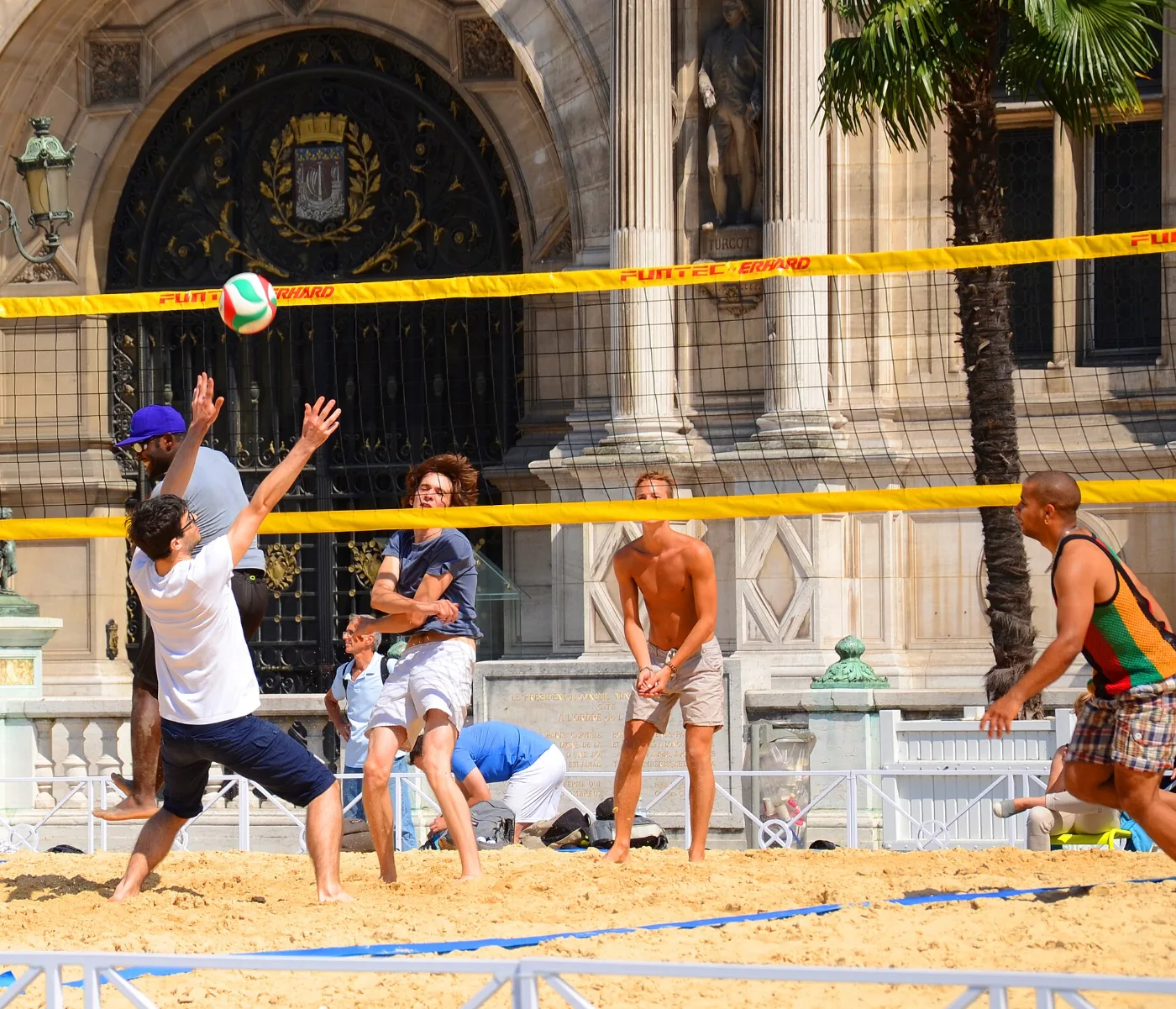
The coaching team around world champion Vyacheslav Krasilnikov structures the warm-up in sand in three stages. The structure matters more than any individual exercise.
Stage 1: getting dynamically warm (4 minutes)
Easy running in sand plus squats, arm and leg swings, torso rotations. The goal is body temperature, not effort. If you can still talk, the pace is right.
Focus on shoulders, hips and knees – the three areas under the heaviest load during play.
Stage 2: mobility (4 minutes)
Now range of motion, but moving, not holding. Lunges with rotation, arm circles large and small, leg swings front and back. Static stretching before playing temporarily reduces jumping power and belongs at the end of a session, not the start.
Stage 3: joints and ligaments (4 minutes)
The part almost everybody skips, and exactly the one that prevents the most common injuries: ankles and knees. Ankle circles both ways, 15 calf raises, then 30 seconds of single-leg standing per side. Plus mobilising wrists and fingers – the finger is responsible for every sixth acute injury after all – it is especially exposed when hand setting in sand.
Important, and stated explicitly in coaching literature: the warm-up must not be too long or too intense. If you are tired afterwards it was not preparation but your first session. If you feel tension anywhere, pause instead of pushing on.
The three areas worth protecting permanently
The lower back. The most common overuse problem of all and a direct consequence of serving and attacking, where the trunk repeatedly goes into extension. Two exercises twice a week are enough: forearm plank 3 times 30 seconds and bird dog, 2 sets of 10 per side.
The shoulder. The longest absence of all. It is not caused by one hit but by thousands. Training external rotation with a resistance band twice a week – 3 sets of 12 per arm, light resistance – lowers the risk considerably.
The ankles. Twisted less often in sand than indoors, but constantly working. Single-leg standing with eyes closed is the best prevention available for free.
The five most common mistakes
Going into the first match without warming up. The classic at a fun tournament: register, draw, first serve. Ten minutes beforehand cost you nothing and save you weeks. Where to play in Berlin is listed in our overview of outdoor courts.
Static stretching before playing. It feels good but temporarily lowers explosive power. Useful afterwards, not before.
Not taping fingers. If you block a lot or set uncertainly, tape them. Every sixth acute injury involves fingers.
Coming back too early. Sand does not forgive half-healing – how to build your capacity systematically is covered in Fit for your beach camp in four weeks – see the absence figures above.
Warming up barefoot on hot sand. Above 30 degrees the surface gets so hot that you unconsciously run faster and land worse. Then wear sand socks – or move the warm-up into the shade.
Common questions
Is beach volleyball more dangerous than indoor?
No, the opposite. Sand takes the impact out of landings, and with only two players per side there are hardly any collisions. Injury frequency is lower than indoors. What is higher is the time you lose when something does happen.
How long should I warm up?
Ten to fifteen minutes are plenty, divided into dynamic warming, mobility and joint work. Longer adds nothing and costs substance. More important than duration is that ankles and shoulders actually appear in it.
Should I brace my ankles?
In sand usually not necessary – the risk of rolling an ankle is much lower than on firm ground. If you have rolled it repeatedly in the past, a brace makes sense. For everyone else, targeted balance work does more than equipment.
My shoulder nags after playing. Keep going?
A pull that disappears after warming up is usually harmless. Pain during the hitting motion or at night is a warning sign – shoulder problems carry the longest absence in beach volleyball. Better to serve underhand for two weeks and have the cause checked than to miss two months.
Does warming up really prevent injuries?
Against acute injuries such as a struck finger only to a limited degree – those happen in duels. Against muscle and tendon problems and against overuse conditions, clearly yes. And it demonstrably improves joint mobility, which in sand translates directly into better movement quality.