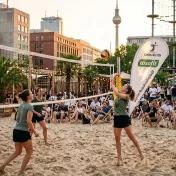
Four weeks until the camp. Technique can hardly be rebuilt in that time – your capacity to take the load can. And that is what decides whether you are still playing on Sunday afternoon or only standing.
Because sand is not a floor, it is a resistance. Underestimate it and you arrive with decent indoor form and are finished after the first morning.
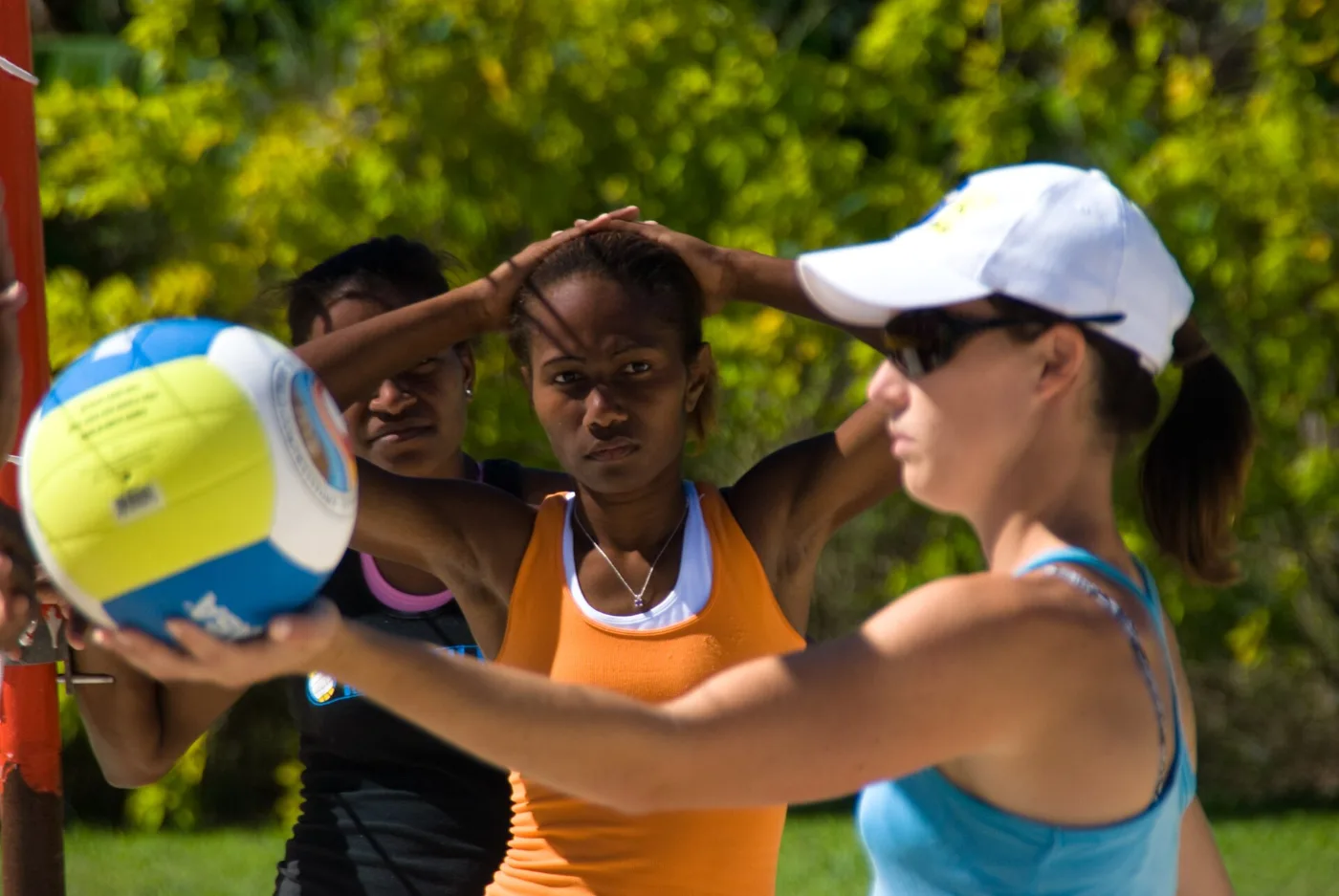
What sand does to you – in numbers
Exercise physiology measurements show fairly clearly why a beach day feels different from an evening indoors:
Walking in sand costs 1.8 to 2.7 times the energy of firm ground. Running costs 1.2 to 1.6 times, depending on pace – at 7 to 14 km/h roughly a quarter more. Jumping is around 1.2 times.
The reason is not the effort itself but lost energy: with every step the sand gives way. On firm ground you get back around 65 per cent of the energy from the previous stride, in sand only about 45 per cent. The elastic return from tendons and muscles is smaller too. You do not bounce, you sink.
A rule of thumb for planning: two hours of beach volleyball are roughly equivalent to an hour of easy running – only with far more jumps and changes of direction. Vladimir Vasiliev, fitness kinesiologist and president of an association for medical fitness, puts it at around 600 kilocalories per hour of play.
The good news is in the same physics: the impact load on your joints in sand is minimal. You train hard for the cardiovascular system and gently for knees and ankles. That is also why sand is the surface of choice when you are coming back from an injury.
What you can change in four weeks – and what you cannot
You can change: acceleration over the first steps, jump endurance, resilience of calves and ankles, general endurance. Exactly the things that run out on Sunday at a camp.
You cannot change: jump height, maximum strength, technique. Anyone who starts rebuilding their serve in the last week before a camp arrives with a half-finished movement.
Larisa Filimonova, lead coach at the Rusvolley volleyball school and a licensed federation coach, sets a clear priority for beginners: twice a week with two days between sessions, moderate intensity, and in terms of content above all – this is the part almost everybody skips – the different ways of moving in sand. Not strength. Locomotion. That is exactly what we work on in our weekly training at Beach 61.
The plan: three sessions a week
Two short conditioning sessions and one session of playing. Each conditioning session takes 25 to 35 minutes. You do not need more, and alongside everyday life you usually cannot take more either.
Week 1 – getting used to it
The aim is for your feet and calves to meet the sand before they have to survive it. Twice 20 minutes of easy running in sand, barefoot, at a calm pace. Afterwards five minutes of ankle work each time: standing on one leg, calf raises, ankle circles. No sand nearby? Soft grass will do.
Expect sore calves. That is normal and exactly the point: it should happen now, not at the camp.
Week 2 – acceleration
Now comes the quality that decides most balls in beach volleyball: the first two steps. Filimonova names explosive strength and starting speed as the central physical qualities in this sport.
Per session: 10 to 12 accelerations over 5 to 8 metres from a standing start, full recovery between them – about 45 seconds. Then 3 sets of lateral jumps over an imaginary line, 20 seconds each.
Week 3 – jump endurance
Not jumping higher, jumping more often. A camp day contains more jumps than three indoor sessions.
Per session: 4 sets of jump squats with 12 repetitions, 60 seconds rest between them. Plus 4 times 30 seconds of skipping rope. The rope looks ridiculously simple and is the most effective calf exercise you can do at home.
Week 4 – back off
The week where most people get it wrong. Halve the volume and leave the last three days before the camp completely free. Training effect happens during recovery, not during load. All dates are on our camps page. Arriving rested means learning more at the camp – which is the actual purpose.
Ankles and calves: what gives out first
In sand the foot works in every movement, because the ground underneath gives way. That is exactly why playing barefoot improves posture and balance – the body has to readjust constantly. And it is exactly why the calf is the muscle that shuts down on day two for the unprepared.
Two minutes a day are enough as prevention: 3 sets of 15 calf raises on both legs, slowly up and even more slowly down. Plus once a day 30 seconds standing on one leg with your eyes closed. If that feels easy, you are ready for sand.
The three most common preparation mistakes
Starting too late and then doing too much. Three hard sessions in the final week do more harm than good. Four calm weeks beat one brutal one.
Only running. Steady running alone does not prepare you for a game made of hundreds of short accelerations. The intervals matter more than the kilometres.
Shoes. If you do the whole preparation in running shoes and stand barefoot in sand for the first time at the camp, you have trained the wrong foot for four weeks. At least half the sessions should be barefoot on a soft surface.
Common questions
I have no sand nearby. What now?
Soft grass is the best alternative, then forest floor. Both give way and force the foot to stabilise. In Berlin sand is cheaper to reach than you think: at most venues you can rent a court for an hour and run there. Two such sessions in four weeks already make a difference.
Should I lose weight before the camp?
Not in these four weeks. A calorie deficit and a build-up of training load go together badly – you would lose exactly the substance that carries you through day two. Weight is a project for the time between camps.
How much preparation does a beginner camp really need?
For a camp at level A1 to A3 it is enough to do something twice a week and not arrive completely untrained. The groups are small and the breaks sufficient. Which level suits you is explained in our A1 to F3 article. From level F1 upwards the pace rises and preparation matters noticeably more.
Sore muscles on arrival day – still take part?
Yes, but warm up longer than usual and take the first session deliberately easy. Muscle soreness is not damage but an adaptation. Sharp pain in the Achilles tendon or ankle is a different matter – that belongs at the doctor, not in the sand.