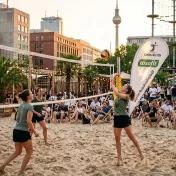
Anyone watching beach volleyball on television for the first time eventually asks the same question: why do they hold fingers behind their back before every serve? It looks like a secret code – and that is exactly what it is. Just a very small one you can learn in ten minutes.
And the best part: hand signals are the only tactical tool in beach volleyball that makes you better immediately, without training anything. You only have to agree on them.

Who signals what, and when?
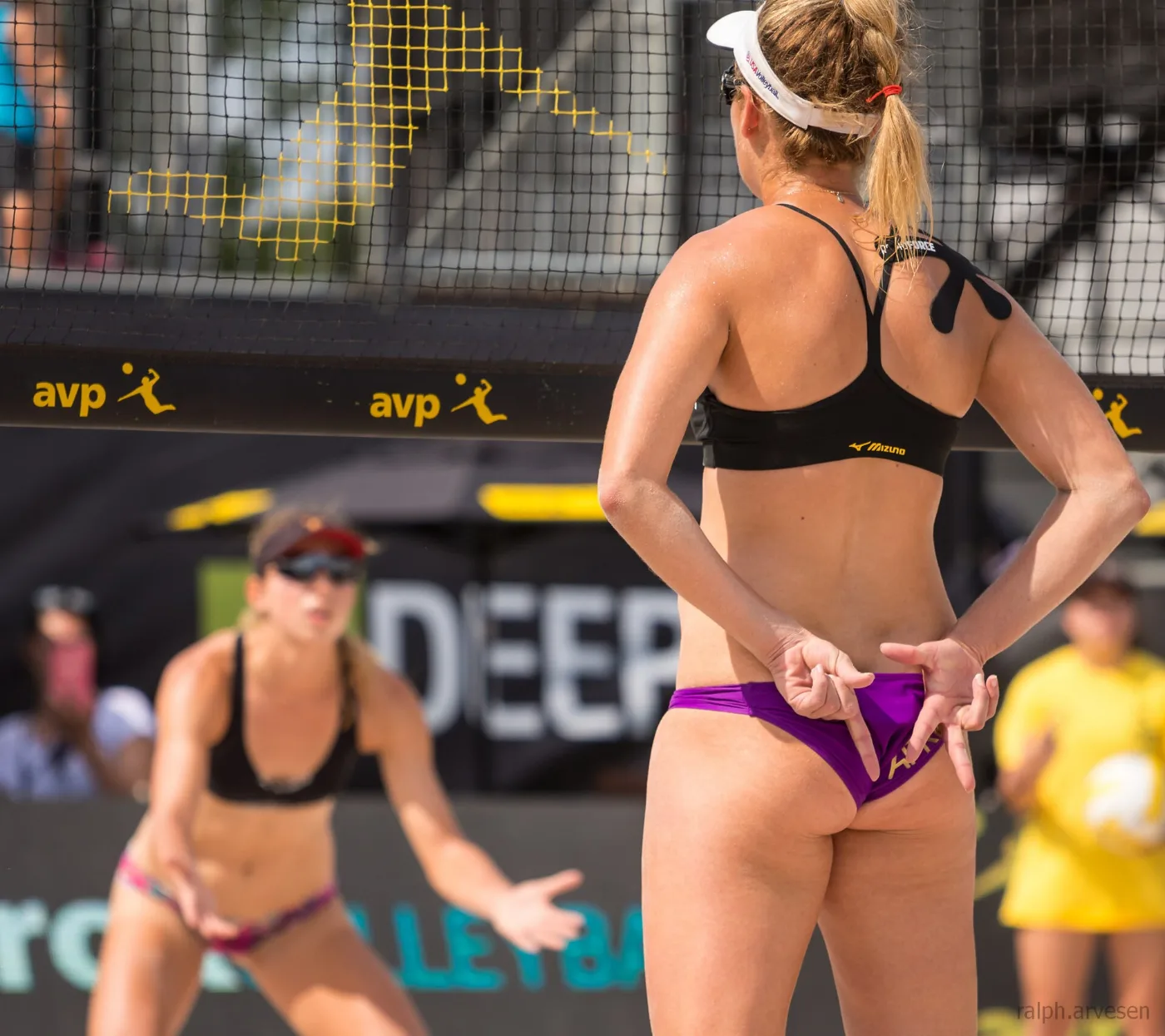
The division is always the same: one of you serves, the other stands at the net and is about to block. The blocker at the net gives the signal – with both hands, behind the back, before the serve is executed. The server glances at it, then serves.
Why behind the back? So the opponent cannot see it. The signal is meant for the partner alone.
And why at all? Because the blocker closes one part of the court and the defender has to cover the rest. If the defender knows in advance which attacking direction the blocker removes, they only need to watch the other. Without a signal they cover everything – and therefore nothing.
The four signals you need
Left is left, right is right
You have two hands because you have two opponents. Your left hand shows how you block the opponent on your left, your right hand the one on your right. This is where beginners trip up – and the only part that really needs a moment of practice. Remember: the hand points at the opponent it refers to.
What “line” and “angle” actually mean
Both terms always refer to the blocker’s view, not the attacker’s.
The line is the narrow section of court directly behind the blocker, parallel to the sideline. The angle is the larger area to the side, across the court.
From which follows a simple logic that surprisingly many recreational players never hear: if the blocker closes the line, the defender stands in the angle. If the blocker closes the angle, the defender goes to the line. The defender is never where the block is.
The complete overview
How to introduce hand signals in recreational play
The mistake almost everyone makes: reading about hand signals, wanting to use all four at once – and after three rallies nobody uses them any more because it was too complicated.
Week 1: two signals only. One finger and two fingers. Nothing else. Even a rough agreed division of the court immediately wins you balls that used to fall between you.
Week 2: add the fist. As soon as an opponent attacks harder than you can block, “no block” is the better decision. That is not giving up, it is tactics.
Week 3: say it out loud. The blocker quietly calls the signal as well: “line” or “angle”. Sounds silly, but prevents the most common cause of misunderstandings – the server not having looked at all.
Week 4: link it to the serve. Now it gets genuinely good. The signal determines where you serve. If you block the angle, serve so the attacker comes from a position where the angle is the obvious swing. From here on you are playing real tactics.
The three most common misunderstandings
1. “The signal is a prediction.” It is not. It is the blocker’s declaration of what they intend to do. They are not saying what the opponent will do – they are saying what they themselves will close.
2. “On a fist the blocker must leave the net immediately.” No. They stay at the net at first and simulate a block. Only once the set is up do they pull off and drop into defence. The opponent should fear a block until the last moment.
3. “It works without signals too.” It does. It only costs you roughly every fifth rally. Two defenders who have not agreed anything both cover the same half – and then wonder where the ball went.
Common questions
Do I need hand signals if I only play for fun?
No, but it is the fastest way to become a better team without playing better. Ten minutes of explanation, effective immediately.
What if my partner does not see the signal?
Then you do not have a signal problem but a routine problem. The server always looks before tossing the ball. That is part of the serving routine.
Are there more signals?
At world level yes – for serve targets or block variations. For everything below that, the four here are entirely sufficient.
Agreements are the cheapest progress in beach volleyball
At camp we build blocking signals and defensive positions straight into live play – not as theory but in real rallies. Groups by level, no more than eight people.