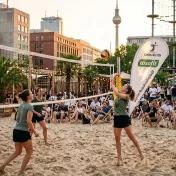
Two people, 128 square metres of sand, and the opponent may hit wherever they like. That is why blocking and defence are not two jobs in beach volleyball but one – and it is the reason small teams beat big ones.
Sergey Sayfulin, a master of sport and later a sports scientist with a doctorate, learned this in 1996 on his debut at a World Championship stop. His team lost to the Canadians Heese/Child, Olympic bronze medallists from Atlanta, 2:15 in 55 minutes – even though his side were taller, jumped higher and hit harder. His verdict years later, as a sports scientist with a doctorate: they simply had no interaction between the block and the court defence. Without it, the only remaining source of points is your own serve.
The mistake almost everybody makes
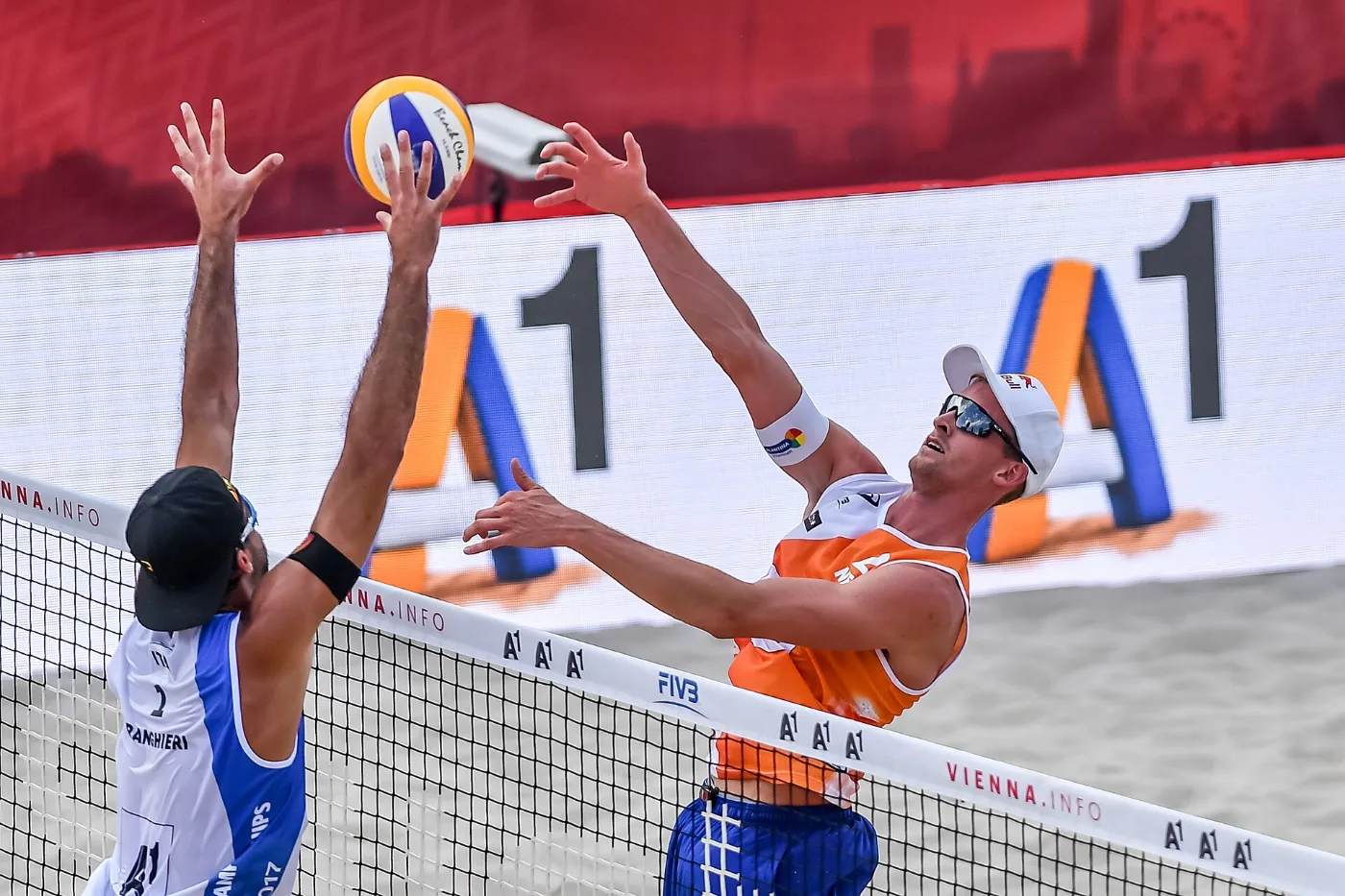
In recreational play it usually goes like this: the blocker stands at the net, the defender looks at which way the block is angled and moves to the other corner. Sounds logical. It is the wrong way round.
Sayfulin describes the defender’s starting position differently, and this is the most important sentence in this article: it does not depend on which direction the block closes, but on where along the net the block is being set. Block on the left of the net? The defender has one base position. Block on the right? A different one. Whether that block takes line or cross changes the base position not at all, at least to begin with.
The reason is geometry. An attacker taking off at the left edge of the net has completely different available angles from one in the middle. The area a defender can realistically reach shifts with the point of attack, not with the position of the blocker’s hands.
In practice: position yourself first according to where the attacker will jump. Only then think about what your blocking partner is closing. Do it the other way round and you will constantly stand too wide.
Three ways to defend the court
There is no single “defence” but three clearly different modes. Most recreational players only know one of them.
1. Passive defence
You take your base position and stay there, including while the opponent attacks. Your starting position is also your finishing position. Some players add small feints with the upper body, left and right or forward and back, without giving up their spot. The Brazilian Zé Marco was known for it. The aim is to unsettle the attacker and the setter without surrendering any court.
This is the defence to start with. It asks the least of you and breaks the least.
2. Active defence
You start in your base position but leave it the moment the opponent has set the ball, moving into the zone where you expect the attack. Get it right and you are there before the ball is. Get it wrong and the court is wide open exactly where you were standing.
Sayfulin names three conditions that must all be met: very good physical condition, a stable mind – because you will often run and still not touch the ball – and complete mutual understanding with your blocking partner. Plus a properly set block, otherwise you are guessing blind.
3. Defence after the hit
You stand as in passive defence but react only to the ball or the hitting hand, then chase it. This is the mode against shots and rolls. It demands starting speed rather than endurance: the first two steps decide everything.
Block or peel?
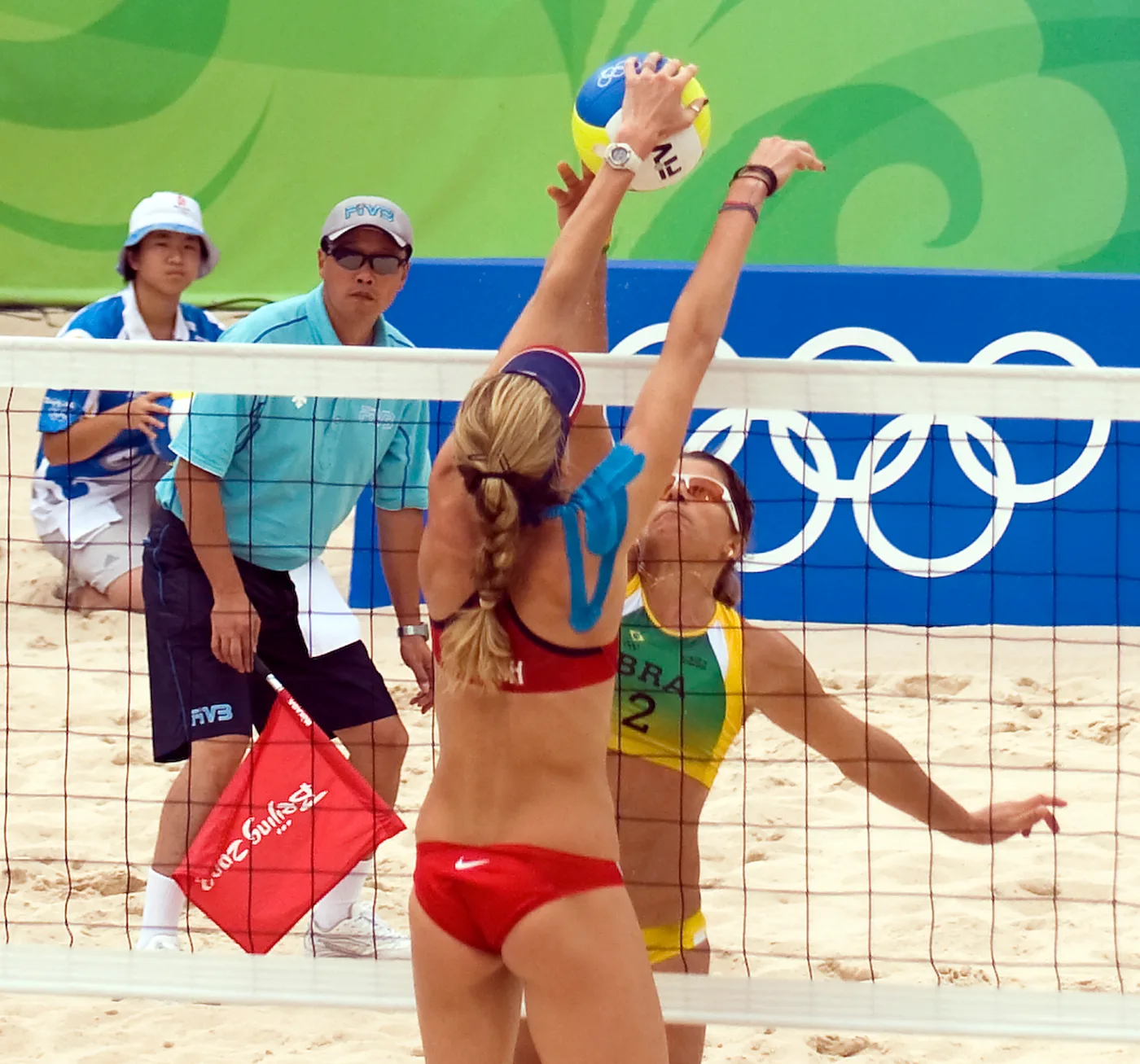
Before every attack the blocker has two options: stay at the net and jump, or release from the net and defend the court. In English this is called peeling or pulling.
The decision rule is simpler than it sounds: stay at the net as long as the opponent can set cleanly. Peel as soon as the set is bad. An attacker chasing a poor pass rarely hits hard – they place the ball. And placed balls are caught in the court, not at the net.
Two situations where peeling is almost always right: the set travels well past the net, or the opponent has to put the second ball over themselves. Neither announces a powerful attack.
Technique at the net: three things that matter
Blocking technique in sand differs from indoor mainly in the take-off. You cannot push off explosively, you would dig yourself in. The rest is craft:
Stance. Knees slightly bent, weight even on both feet, hands in front of the body at shoulder height. From there you can move in any direction – including backwards, in case you peel after all.
Timing of the jump. The most common error is going too early. In sand you rise more slowly and stay up for less time than on a wooden floor. Wait until the attacker starts the hitting motion.
Arms and hands. Arms straight and firm, fingers spread – that noticeably increases the blocking surface. Players who block a lot tape their fingers for extra stiffness. The coaching staff around world champion Vyacheslav Krasilnikov recommends exactly that.
And the tactical part: blocking means reading. Watch where the opponent stands, how they approach, where their set goes. With only two opponents in the sand there are a manageable number of signals – you just have to look at them deliberately.
The block counts as the first contact
This is the rule difference that catches out indoor players in their first sand match. Indoors a block touch does not count as a contact, the team still has three hits afterwards. In beach volleyball it does count. After a block touch your team has only two contacts left.
Concretely: you block, the ball drops into your own court, your partner digs it – that was contact two. The third ball has to cross the net. And yes, as the blocker you may play the next ball yourself: no rule forbids two consecutive contacts by the same player after a block.
Another rule that surprises people: you may not block the serve. A ball coming directly from the serve may be neither blocked nor attacked above the height of the net. You have to wait until it crosses the plane of the net or drops below the net edge.
The four most common mistakes
The defender watches the block instead of the attacker. Your blocking partner gave a hand signal before the serve – that is all you need from them. Your eyes belong to the opponent.
The blocker jumps on principle. A block against a ball the opponent can only place is surrendered court. How attackers place those balls is covered in our article on the five shots. Peeling is not a sign of weakness.
Both go for the same ball. This happens whenever nothing was agreed beforehand. The fix is hand signals, not more running.
Active defence without agreement. If you set off and your partner does not know, a hole opens that nobody covers. Active defence only works as a team decision.
Common questions
Should I block at all if I am short?
Yes, but less often. A block does not have to stop the ball to work – it narrows the angles and forces the attacker to decide. If you are clearly shorter than your opponent – our A1 to F3 level system helps you place yourself – peeling pays off more often, because you reach more balls in the court than at the net.
How do I find my base position?
Start by standing where the attacker’s cross-court shot would land and adjust from there. What matters is that you are there before the attack and standing still. A defender who is still moving at the moment of contact cannot react.
What do I do after a block touch?
Turn immediately and look into the court. After a block touch the ball is often slow and drops just behind you. And remember: your team has only two contacts left.
Do we block line or cross?
A rule of thumb for recreational play: close the line, leave the cross to the defender. The cross is the longer path, which leaves more reaction time. Against opponents who almost only hit cross, reverse it.