An indoor player’s first day on sand nearly always follows the same script. The first ten minutes feel wonderful – sunshine at last, fresh air at last. After twenty minutes the first irritation arrives. After an hour someone who sets at a decent league level indoors is sitting on the sideline seriously wondering whether they ever knew how to play volleyball.
This is not embarrassing, it is physics. Beach volleyball is not indoor volleyball outdoors. It is a different sport that happens to use a similar ball. Players who grasp that have settled into the sand within three weeks. Players who do not spend the whole summer fighting themselves.
What actually changes – the honest overview
The decisive line is the second one. You are suddenly responsible for two and a half times the area. There is no libero taking the awkward balls, no middle blocker shutting the line, nobody standing behind you when you misjudge one. There is you and one other person. That is the real culture shock – not the sand.
Mistake 1: you jump like you do indoors
Indoors you give the floor energy and get it back. Sand takes it and keeps it. An approach that produces a clean attack inside ends up outside as a jump that is too low, too late and too far forward.
The adjustment: shorter approach, wider steps, deeper plant, more arm swing. Above all, the last step goes down into the sand, not forward across it.
Two technical details that do not matter indoors: first, take-off on sand is frequently off one foot rather than two – it preserves balance on an unstable surface far better than the explosive indoor plant. Second, the slide step replaces the indoor shuffle step. And the arm swing becomes flatter and more controlled, because sand will not transmit the power anyway.
Your jump will never again match your indoor jump. That is normal and applies to everyone – including whoever is on the other side. What does get loaded far more heavily are the stabilising muscles in the ankles, hips and core. Those are exactly what makes you sore in the first weeks.
Mistake 2: you insist on hand setting
The bitter moment for every setter: on sand the overhand set is judged far more strictly than indoors. Double contacts nobody would mention inside are a fault outside. Add wind that moves the ball on its way to your hands.
The adjustment: learn the bump set. On sand it is not the emergency option but the standard – wind-stable, rule-safe, more reliable under pressure. Hand setting stays legal and useful, but it is no longer the first choice on every ball.
Mistake 3: you swing at everything
The indoor reflex says: ball up, ball down. On sand the defence is not spread across six positions but two – yet it only has two people to read. A hard swing at an alert defender is often the worse ball on sand.
The adjustment: learn shots. Cut, line shot, poke, the deep ball to the back corner. Three variations win more points on sand than one big swing repeated thirty times. Beach volleyball rewards ideas more than power.
Mistake 4: you still think in positions
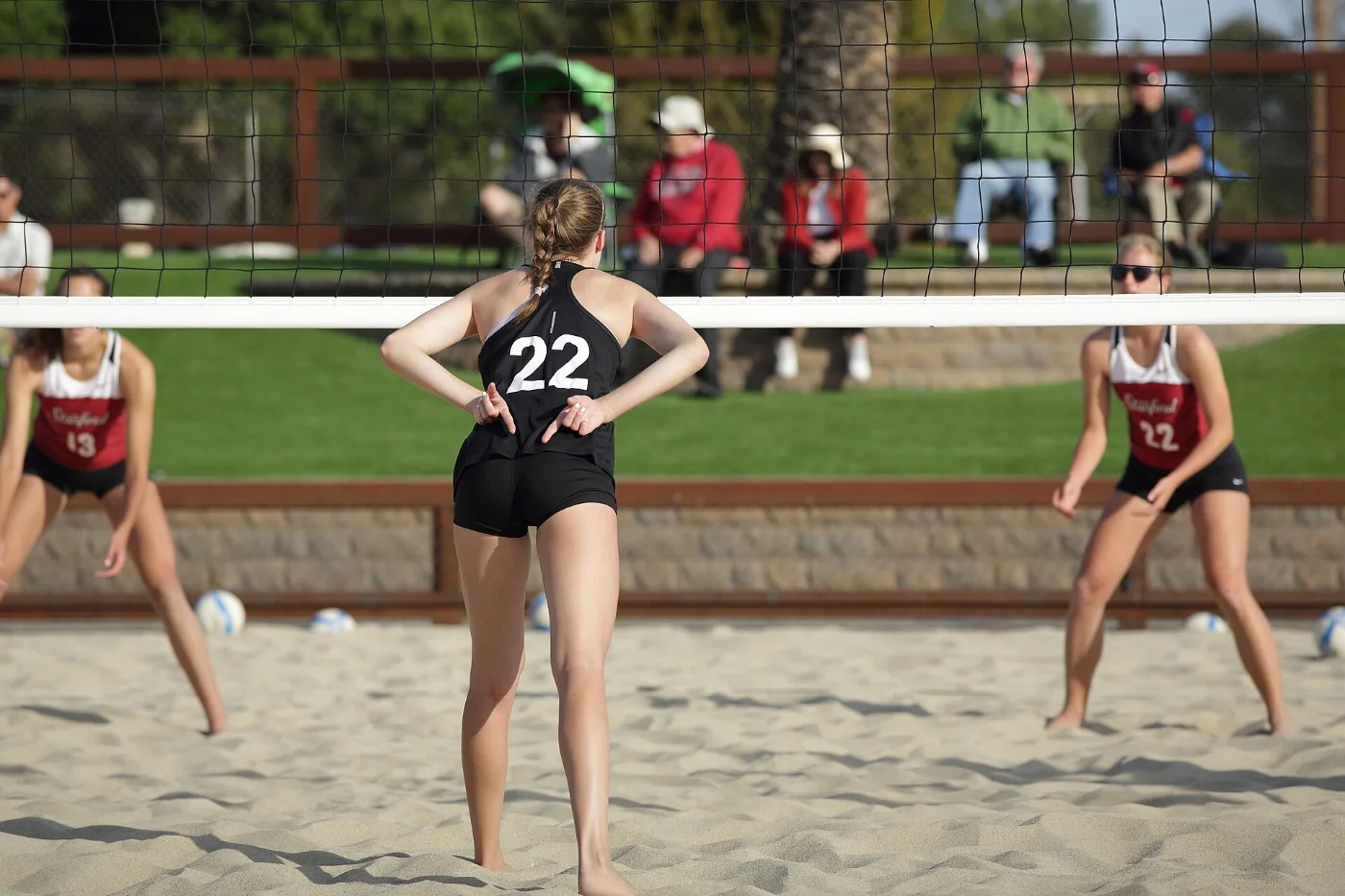
“I’m an outside hitter” is a sentence without meaning on sand. You pass, you set, you attack, you block, you defend – often all of it within two rallies. Heavily specialised players struggle more at first than all-rounders who never shone indoors.
The adjustment: the only division of labour that counts on sand is blocking or defending. You need both. Anyone with only one is predictable.
Mistake 5: you ignore the wind
Indoors, air is a neutral medium. Outdoors it is a third opponent that switches sides when you do. A serve with the wind behind you that lands in on a still day goes two metres long outside.
The adjustment: check the wind briefly before every serve – flags, net tape, sand in the air. Into the wind you can hit much harder; with the wind you have to play shorter and flatter. And the most important sentence about wind: it is the same for both sides. Getting annoyed by it means losing twice.
A reality check for week one
Your success rate drops, your jump gets lower, your legs get heavier. That is not regression, it is adaptation. After roughly three or four sessions on sand the surface starts to feel normal – and from then on your indoor experience genuinely starts to pay off.
What you bring from indoors – and it is a lot
The frustration of the first weeks hides how big your head start really is. Indoor players arrive with:
- Ball feel. Complete beginners need a year for that; you already have it.
- Arm swing. The mechanics are right, only the take-off has to adapt.
- Game reading. You know where the ball is going before it gets there. On sand that is worth even more than indoors.
- Serving technique. Only needs adapting to wind, not relearning.
That is why former indoor players regularly overtake sand-only beginners after about two months. The first weeks are a dip, not a decline.
A realistic transition plan
Weeks 1–2: legs. Do not play for results. Jumps out of sand, movement patterns, landings. The only goal is to make the surface feel normal.
Weeks 3–4: setting. Bump setting until it is boring. Whoever puts up a clean second ball is the reason the third one exists.
Weeks 5–6: attacking options. Cut and line shot, deliberate rather than hard. Full swings come after that.
Weeks 7–8: serve and wind. Serve in every condition, consciously into and with the wind.
Common questions
Will I lose my indoor technique on sand?
No. Many players report their indoor game improves after a beach summer – especially jumping power and ball control under pressure.
How long does the transition really take?
Three or four sessions for the legs, roughly two months for the game. Playing twice a week, you are a different player in August than you were in June.
Should an indoor player take a beginner course?
No. You do not need a course that teaches ball feel, you need one that teaches the sand-specific movements. That is a different course.
Transition with guidance instead of trial and error
In our camps indoor players train exactly the four things that differ on sand: take-off, bump setting, shots and wind. Groups by level, no more than eight people.